The takeaway
In this article
- 01How much did PSA 10 prices jump?
- 02Did the Japanese gold cards rise too?
- 03What did PSA announce?
- 04Which cards are affected?
- 05Why pay more for a card that may deteriorate?
- 06What should you check before buying one?
- 07How solid are these prices?
- 08What should collectors watch next?
- 09Quick answers
- 10Sources
01
How much did PSA 10 prices jump?
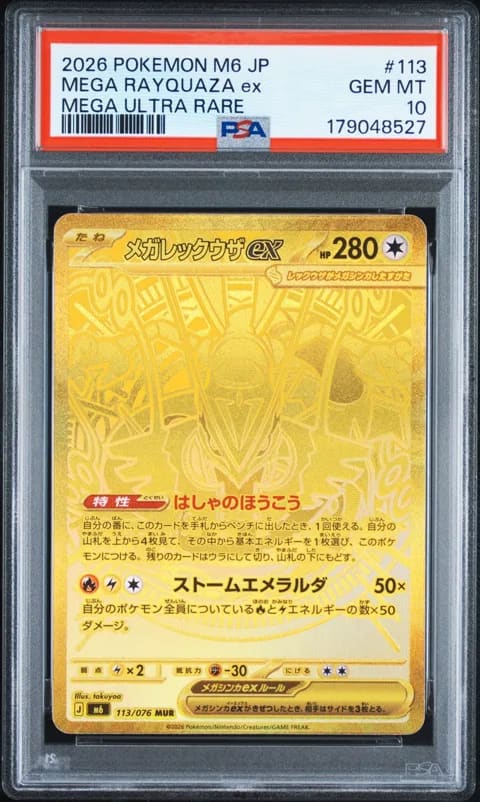
PSA grades cards from 1 to 10, and PSA 10 (Gem Mint) is its top grade. Below is the median sold price (half the sales above it, half below) of each card’s PSA 10 sales in the two weeks before PSA’s notice, against every sale since. Switch to the Japanese gold cards, which PSA still grades, to see the difference.
Two collector terms in the table: a card’s pop (population) is how many copies PSA has graded, here at PSA 10 (see what a population report tells you); its gem rate is the share of all its graded copies that came back a 10 (see gem rate explained). A graded card sits in a sealed, numbered case, a slab.
Cards that reached the notice with well over a thousand PSA 10s already graded, like the two Charizards and Lucario, rose by less.
Prices this new can move fast. Watch a card’s PSA 10 tier on Assetra to hear about the next sale.
Watch Mega Rayquaza exGold Mega cards at auction02
Did the Japanese gold cards rise too?
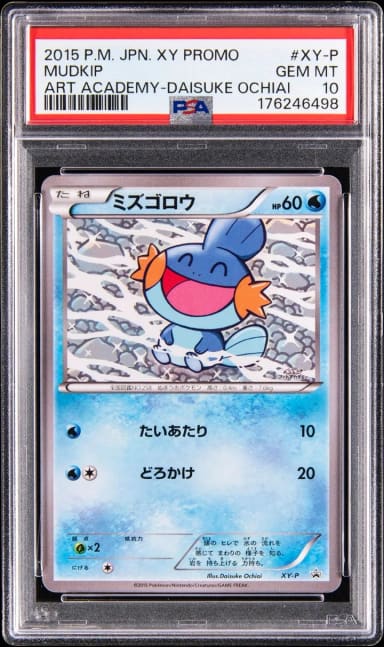
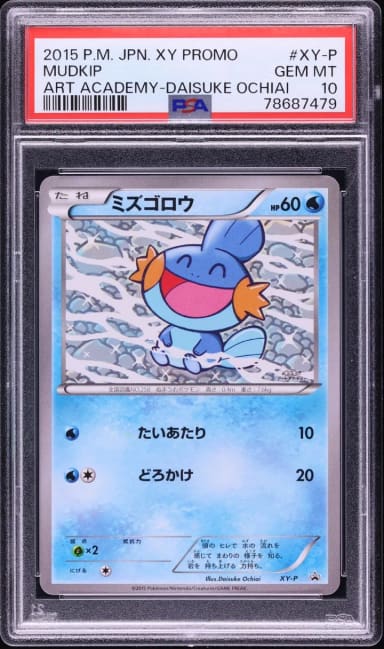
This is the clearest test of what is driving the prices. Eight of the nine English cards have a Japanese gold counterpart of the same Pokémon. The Japanese cards were made differently, PSA still grades them, and they faced the same week of news. If collectors were simply excited about gold Mega cards, both would rise. Mega Charizard Y ex is left out: Assetra’s catalogue has no Japanese gold printing of it to compare. The chart above has the toggle; here are the figures side by side.
The English cards jumped; the Japanese ones moved far less. That points to the one thing that changed for the English cards alone: from 25 November, no new copies can get a PSA grade. (More on how the two languages are priced in Japanese vs English Pokémon cards.)
03
What did PSA announce?
On 25 November 2026, PSA announced that it would no longer grade English-language Mega Hyper Rare Pokémon cards, effective immediately. Mega Hyper Rare is the all-gold rarity at the top of the English Mega Evolution sets. PSA’s reason, as reported: a manufacturing issue “can cause the gold foil on the front to deteriorate over time”, and continuing to grade the cards “wouldn’t meet the standard of accuracy and consistency that collectors rely on us for.”
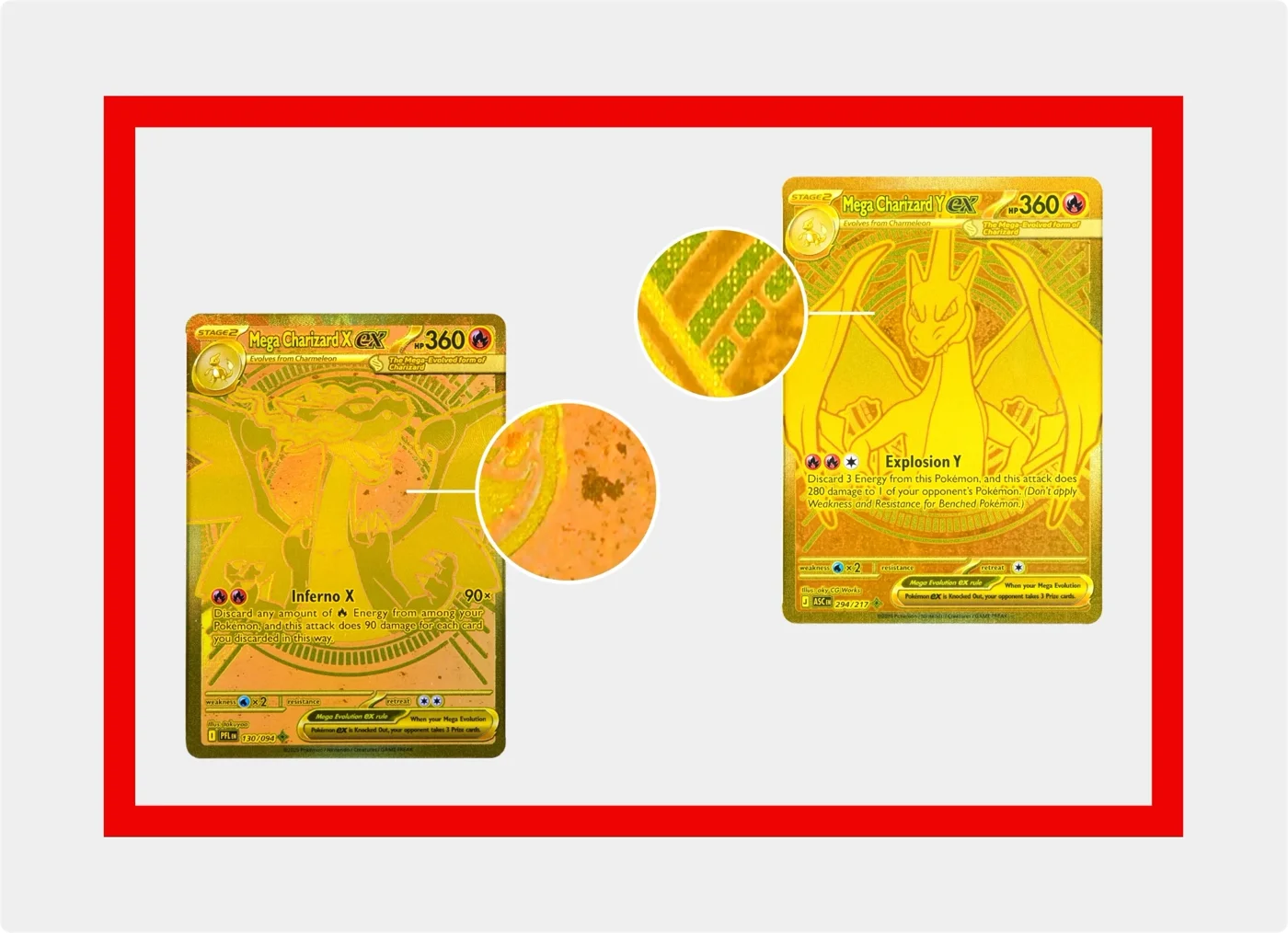
- Where it shows up. PSA has seen the foil fade or develop patches in raw cards (ungraded, not in a slab), in binders and inside its own slabs, so it puts the cause in the card, not in how it was stored. Some cards are badly affected, others not at all.
- Cards already sent in are returned ungraded, and the grading fee is not charged.
- Grades already given stand. But a card sent back for PSA’s Review or Reholder service (returned to PSA to be re-checked or re-cased) is judged on its condition at that time.
- The PSA Guarantee covers PSA’s own grading mistakes, not a manufacturing defect that appears after grading.
- Future English Mega Hyper Rares are covered too, unless PSA says otherwise. No date has been given for grading to resume.
- Japanese cards are not affected. The Japanese gold cards (called Mega Ultra Rare in Japan) were printed at a different facility with different techniques and have not shown the problem. They can still be graded.
04
Which cards are affected?
Nine English cards, across seven sets. The gold Hyper Rares from the earlier Scarlet & Violet sets (the ones marked with three gold stars) are not on PSA’s list, as Pregrade reports.
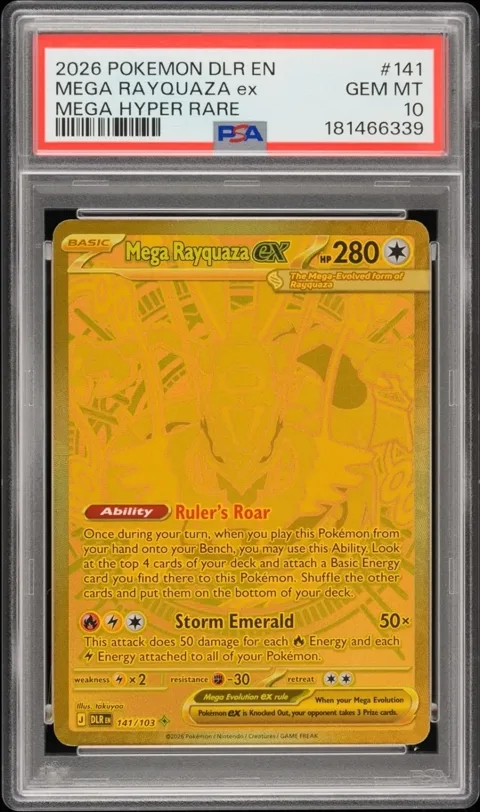
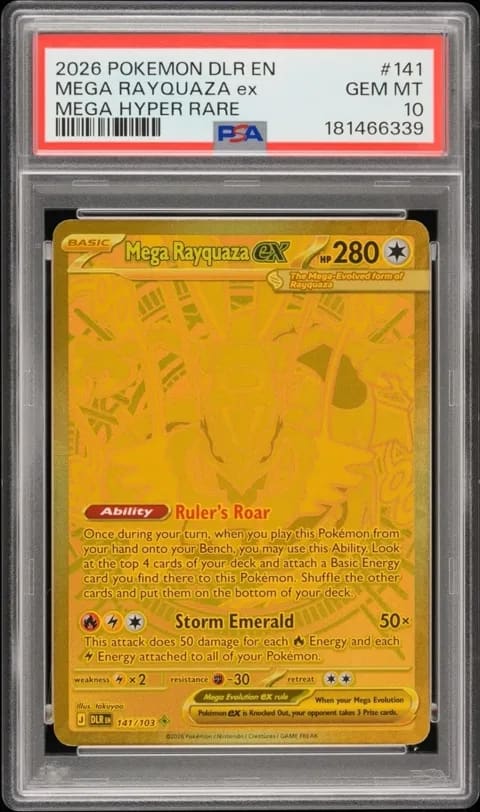
Mega Rayquaza ex
Delta Reign 141/103
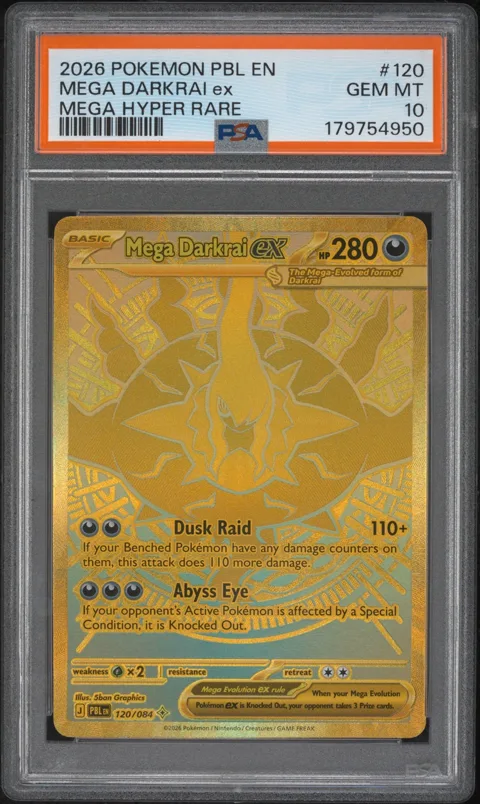
Mega Darkrai ex
Pitch Black 120/084
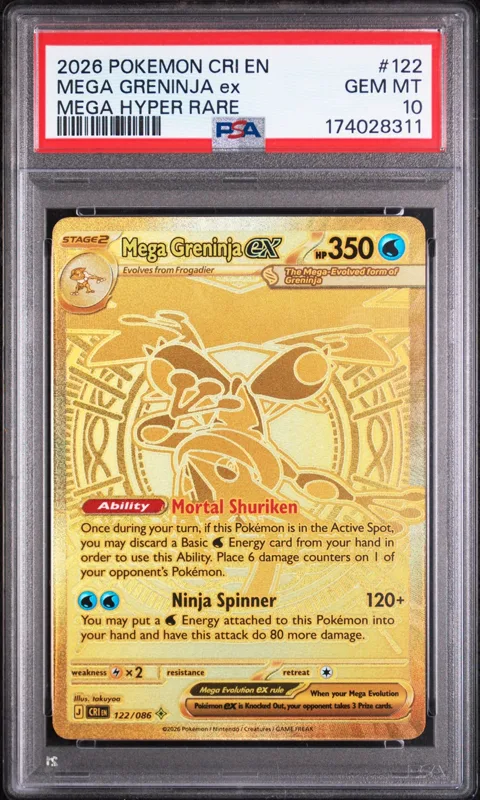
Mega Greninja ex
Chaos Rising 122/086
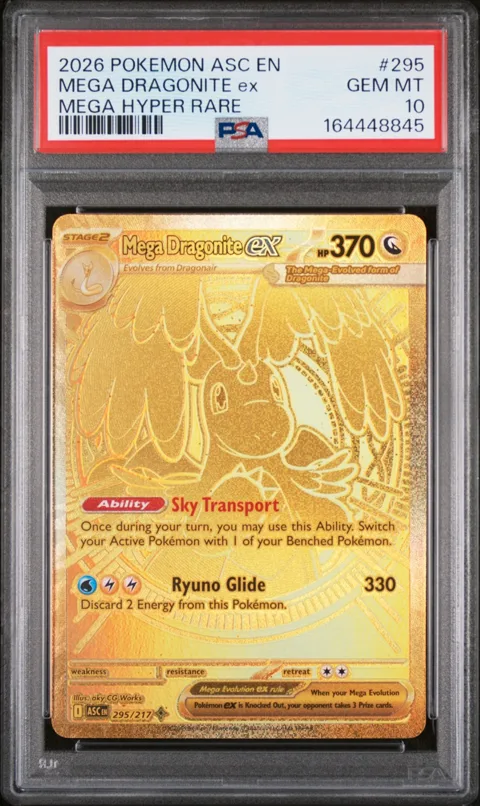
Mega Dragonite ex
Ascended Heroes 295/217
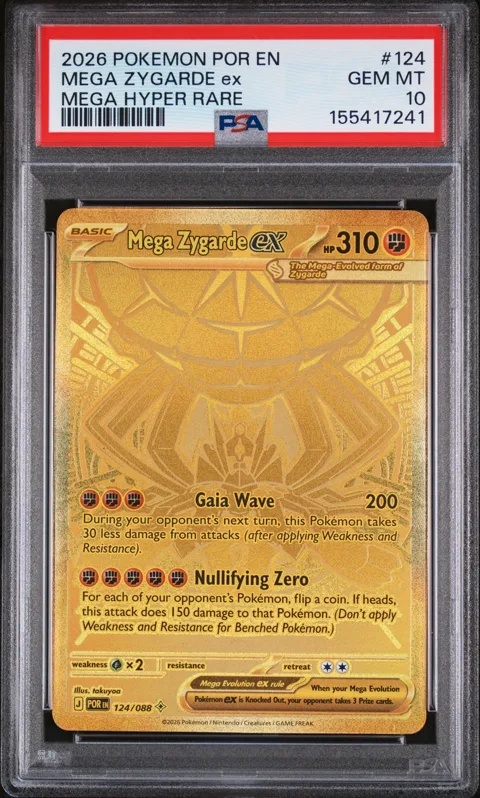
Mega Zygarde ex
Perfect Order 124/088
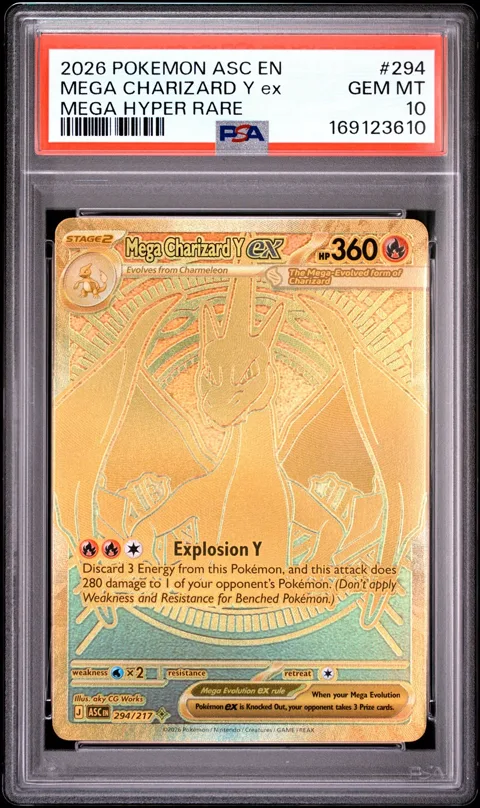
Mega Charizard Y ex
Ascended Heroes 294/217
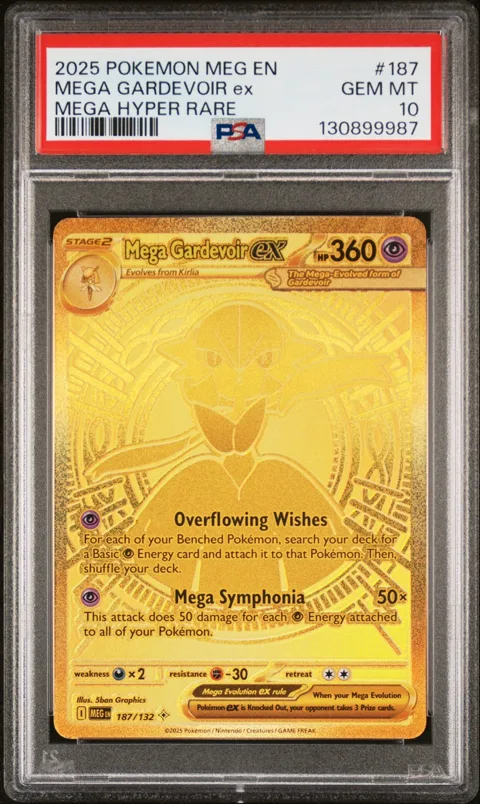
Mega Gardevoir ex
Mega Evolution 187/132
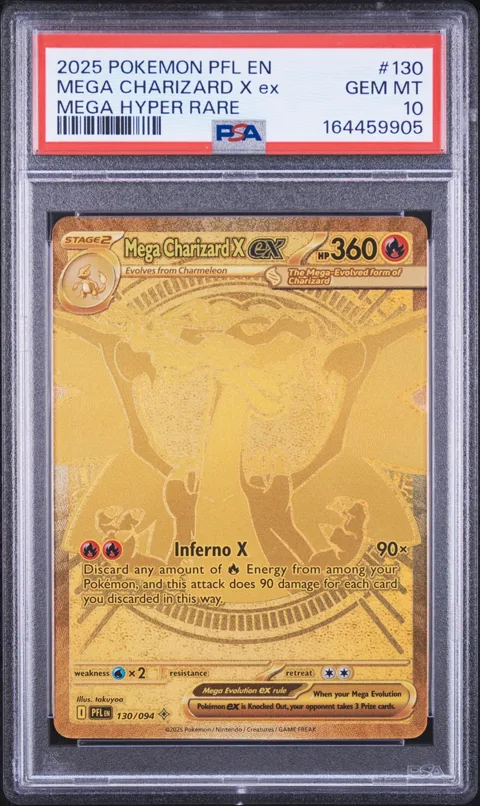
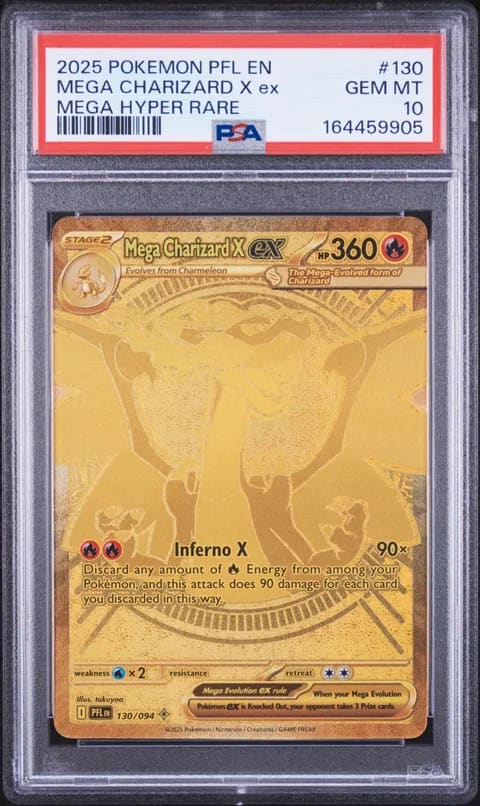
Mega Charizard X ex
Phantasmal Flames 130/094
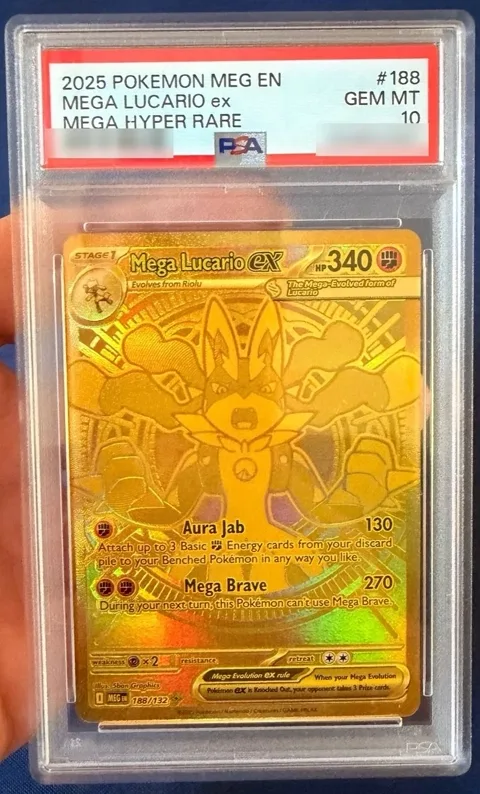
Mega Lucario ex
Mega Evolution 188/132
The earliest, Mega Gardevoir and Mega Lucario, came out in the first Mega Evolution set; the newest, Mega Rayquaza, in Delta Reign, released on 6 November 2026, less than three weeks before PSA’s notice. That is why the newest cards have the fewest PSA 10s: the older cards had months to be graded, the newest only days.
05
Why pay more for a card that may deteriorate?
Two things happened at once, and they pull in opposite directions.
- No new English PSA 10s. The population of each card is now close to fixed at PSA. Buyers who want an English gold card in a PSA 10 slab can only buy one that already exists.
- The label may stop matching the card. PSA has seen the foil change inside its own slabs. A PSA 10 label says what the card looked like when it was graded. Two slabs with the same label could hold cards in different condition a year from now, and the Guarantee does not cover that.
So the price rise rewards scarcity in the label, not certainty about the card. Nobody has yet shown how many slabbed copies are affected or how fast the foil changes.
06
What should you check before buying one?
- Ask for new photos of the actual slab, front, in daylight and at an angle, taken now. A scan from the day it was graded cannot show a change since.
- Look at the gold. PSA describes fading and patches in the foil, like the dark spots on the Charizard X in PSA’s example above. Compare the surface with the other PSA 10 photos on the card’s Assetra page, where every recorded sale shows its slab.
- Check the price against completed sales, not listings. The jump is a few days old. Asking prices have run ahead of it, and a card’s page shows what copies actually sold for.
- Keep the timing in mind. A price set in the first days after a shock can move quickly in either direction as more slabs are listed.
If you already own one, PSA’s grade stands. Sending it for Review or Reholder means it is judged as it is now, so look at it closely first. Whether to sell into the jump or hold is a bet on two things this page cannot settle: whether prices hold once the first wave of buying passes, and whether your card’s gold stays clean. Recent photos of your own slab, kept with the date, are worth having either way.
07
How solid are these prices?
Treat the after-the-news figures as a first read, for four reasons:
- Few days. “Since” covers only the days after 25 November. The first buyers after a shock are rarely the last word.
- Fixed-price sales. Many of the new sales are eBay fixed-price listings marked sold. If a listing closed on an accepted offer, the price recorded may be the asking price rather than the price paid. Auctions, like the three Rayquaza sales on 27 November, do not have that problem.
- Payment. The figures leave out sales the marketplace reports as unpaid, but a sale can still fall through after we record it.
- Populations still settle. PSA’s counts may still change as cards graded before the notice are entered. Assetra shows today’s count, not its history.
08
What should collectors watch next?
- The other graders. As of 28 November we found no statement from CGC, Beckett (BGS) or TAG on these cards. If one stops too, the cards it has already graded become scarce in the same way.
- The Pokémon Company. We found no statement yet on the cause, on replacements or on how future English gold cards will be printed.
- Documented changes in slabs. Photographs of a graded card next to its own earlier photos are the evidence that would show how widespread the problem is.
- The English to Japanese gap. Whether it holds, widens or closes once the first wave of buying passes.
Open the English Mega Rayquaza ex or the English Mega Charizard X ex and press Watch to be told when the next PSA 10 sells, or see gold Mega cards up for auction now.
09
Quick answers
- Does PSA still grade English gold Mega cards?
- No. Since 25 November 2026 PSA returns English Mega Hyper Rares ungraded, with no grading fee charged.
- Are existing PSA grades on these cards cancelled?
- No. Grades already given stand. A card sent for Review or Reholder is judged on its condition at that time.
- Can Japanese gold Mega cards still be graded?
- Yes. PSA says the Japanese Mega Ultra Rares were printed differently and have not shown the problem.
- Does the PSA Guarantee cover the foil problem?
- No. It covers PSA's grading mistakes, not a manufacturing defect that appears after grading.
- Are the Scarlet & Violet gold cards affected?
- No. The notice covers the English Mega Hyper Rares; the gold Hyper Rares from the Scarlet & Violet sets are not on the list.
- Will PSA start grading them again?
- PSA has given no date.
10
Sources
- PSA: PSA to stop grading English-language Mega Hyper Rare Pokémon cards (25 November 2026). The announcement and its example photograph of the foil deterioration. PSA's site refused our automated reads; the policy details above are as reported by the three articles below, which agree.
- Pregrade: This Week in the Hobby, 27 November 2026. The nine cards by set and number, PSA's quoted reasons, the return of submissions with no fee, Japanese versions unaffected, the Scarlet & Violet gold Hyper Rares not on the list; no reported response from CGC, BGS, TAG or Pokémon.
- Backseat Gamer: PSA stops grading gold Mega Hyper Rare Pokémon cards. Deterioration seen in raw cards, binders and PSA holders; the Guarantee; Review and Reholder judged on current condition; future English Mega Hyper Rares included.
- Factioz: PSA halts grading of English Mega Hyper Rare Pokémon cards over gold foil defect. Japanese Mega Ultra Rares printed at a different facility with different techniques; existing grades not revoked; fee waived.
- PikaWiz: Mega Rayquaza ex (Delta Reign), release date. Delta Reign on sale from 6 November 2026; 141/103 is the Mega Hyper Rare.
- Assetra: the nine English and eight Japanese card pages linked in the tables. Every PSA 10 sale, the PSA populations and each card's estimate, read live.
About this article
Written and checked by Assetra. Prices and populations come from completed sales and the graders’ population reports as recorded in Assetra’s ledger; see how Assetra builds its figures. Spotted a mistake? Tell us.