The short answer
In this article
01
A real cert number is not a real slab
PSA documented PSA says so on its own cert verification page: checking a number does not eliminate risk, because criminals copy genuine certification numbers from public records onto counterfeit labels. A lookup proves the record exists. It does not prove that the slab in front of you is the one PSA graded.
That is not a theoretical risk. In January 2026 a federal jury in Manhattan convicted Anthony Curcio of wire fraud for selling sports and Pokémon cards in altered PSA holders: real labels with the grades and serial numbers changed, used to sell lower-grade cards as 9s and 10s.
So check for three different kinds of mismatch, in this order:
- The record. PSA’s record names a different card, set, variety or grade from the label. Stop.
- The card. PSA’s own photograph of that cert shows a physically different card. Stop and ask PSA.
- The holder and label. The case or the printing looks altered against genuine slabs of the same period. Investigate before you pay.
Type the number into PSA’s cert page yourself rather than following a link or a QR code a seller sends: a lookalike website can show a perfect record.
02
Compare the card with PSA’s own scan
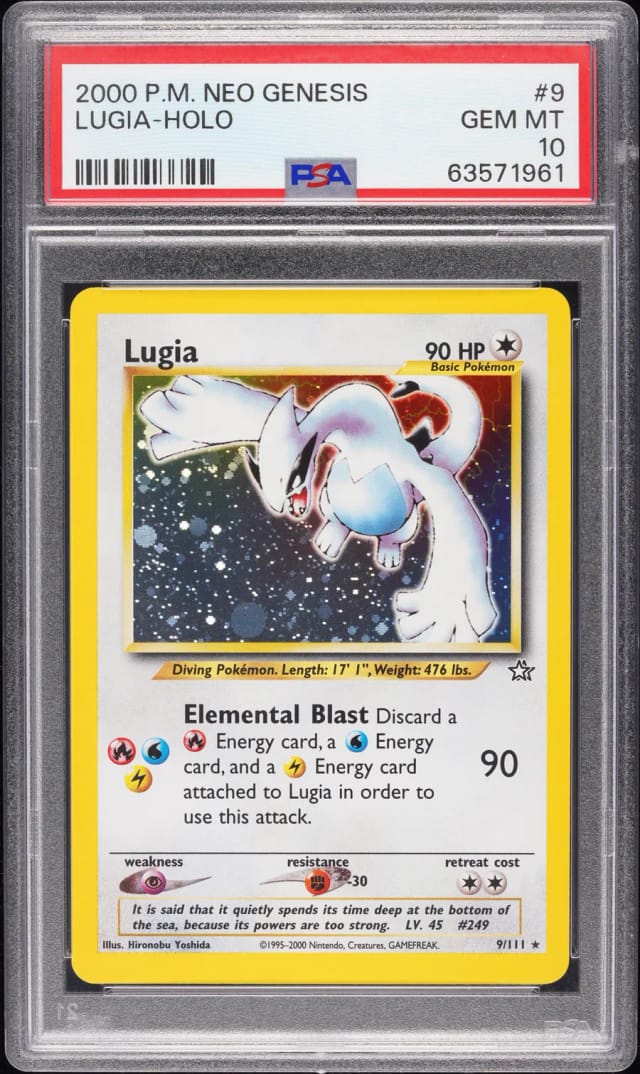
Photo check For most cards graded since 2019, PSA’s cert page shows its own high-resolution scan of the front and back of the slab. A counterfeiter can copy a number and print a label; reproducing the exact card PSA photographed is much harder. On a holo card the foil starfield, the print dots, the centering and the edges are a fingerprint of one physical copy.
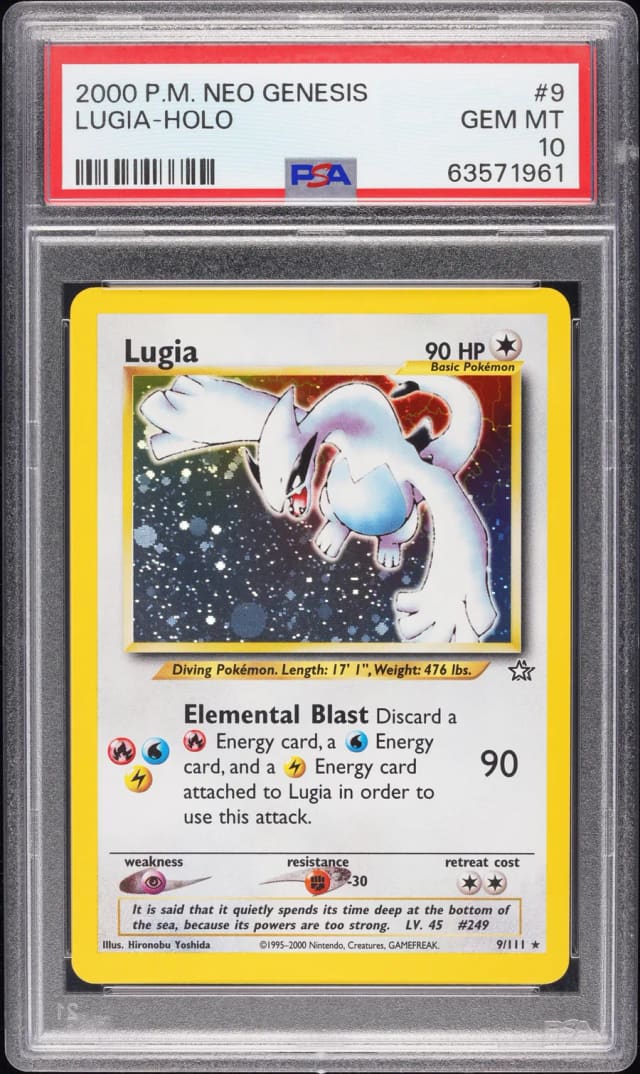
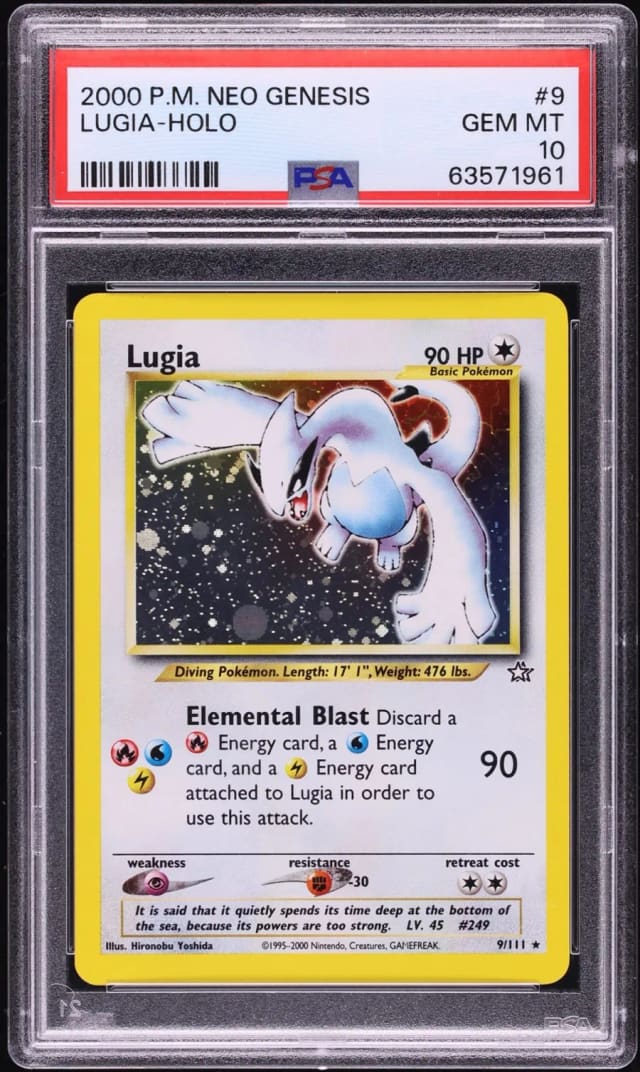
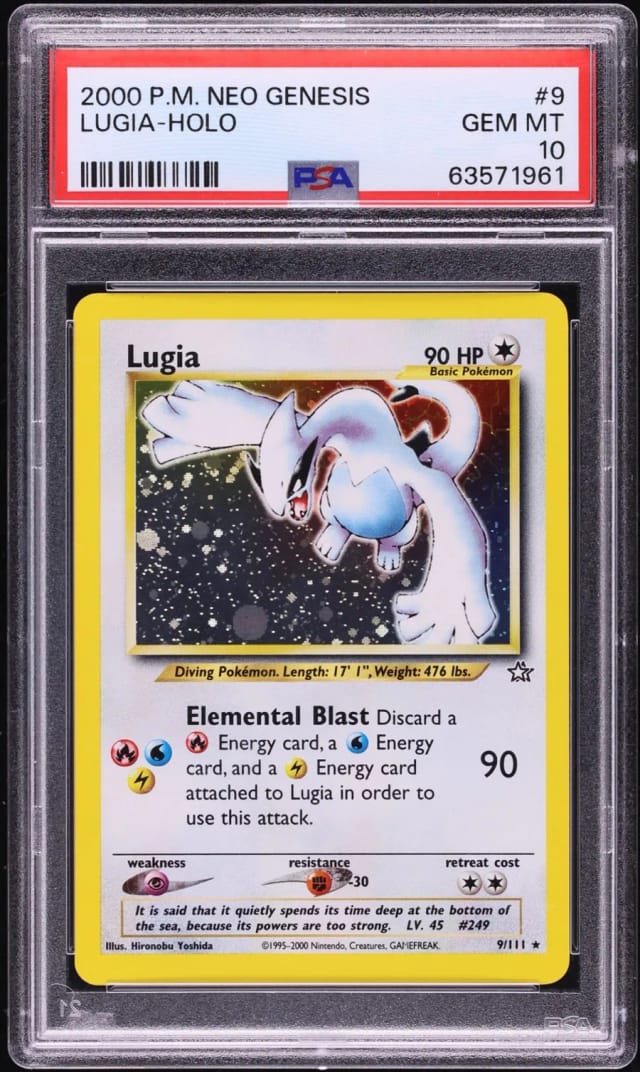
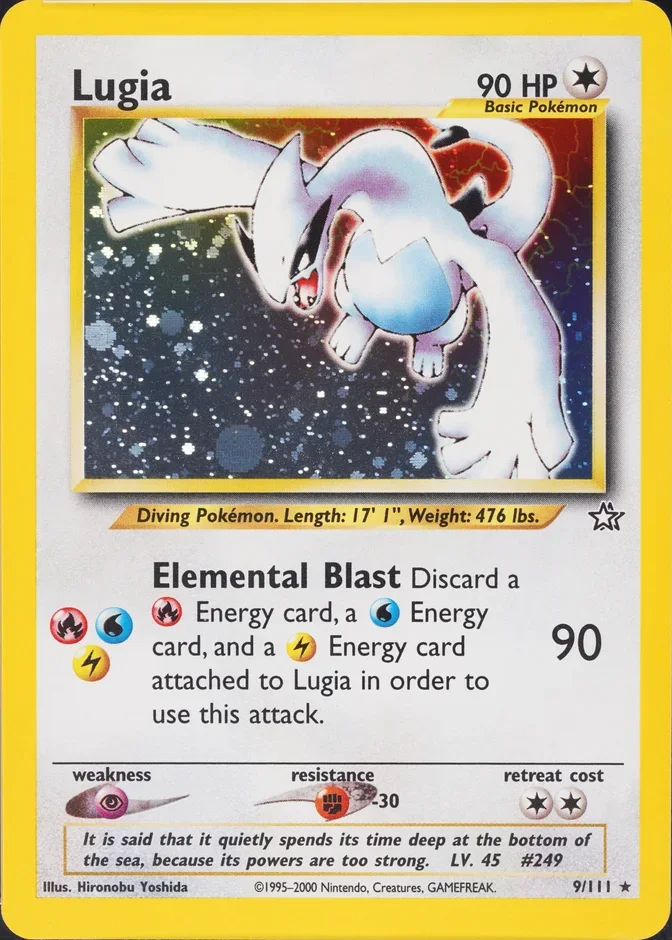
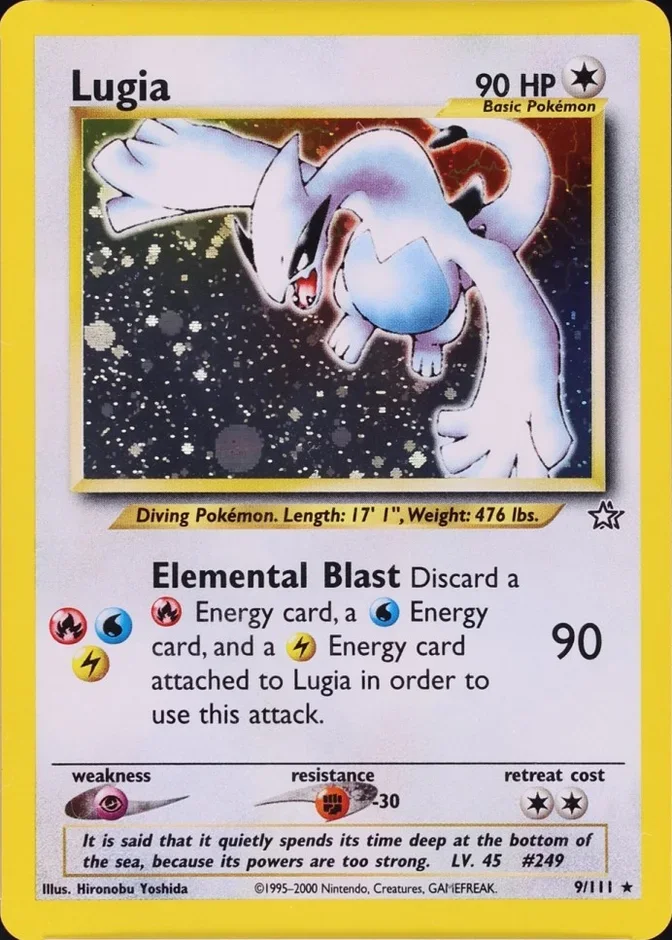
Here is a genuine example from Assetra’s ledger: a 2000 Neo Genesis Lugia PSA 10, cert 63571961, which sold on Fanatics Collect for $180,000 including buyer’s premium on 14 September 2026. One photograph is PSA’s scan; the other is the auction’s. Use the tools to check that they are the same card.
- 1The large round foil disc low in the holo window, left of centre
- 2The disc at the left edge of the window, level with the wing
- 3The smaller disc just right of it, under the wing
What to compare, from strongest to weakest:
- The holo pattern. The position of distinctive foil stars and discs relative to the artwork and the frame. Brightness changes with the light; position does not.
- Centering. The width of the border on each side. A card plainly off-centre in PSA’s scan cannot be well centred in the listing.
- Print marks. Dots, specks, edge whitening and corner shape. A PSA 10 has few, which makes the foil all the more useful.
- The back. PSA scans the reverse too. Compare its centering and edges with the seller’s photo of the back.
Do not expect the two photographs to match pixel for pixel: scanners and cameras light foil differently. And a matching photograph shows only that the photo is of the right card. A seller can photograph a genuine slab and ship a different one, so ask for new pictures taken today, with the date and your username on a note in the frame, and for a high-value slab a short video tilting it under light.
No PSA scan for a cert is not, on its own, a warning: PSA began imaging slabs with submissions from January 2019, and older slabs often have none. It does mean you lose the strongest check, so the others matter more.
03
Read the QR code itself
Collector-reported Current PSA labels carry a QR code on the back that opens the cert record. In October 2026 collectors on Elite Fourum examined suspected altered labels and found their QR codes encoded an address ending in /psa, for example psacard.com/cert/65821932/psa, where genuine labels encode one ending in the number and a slash. The collector who reported it checked about 1,300 slabs and found the ending on none of them, and was careful to add that this cannot guarantee every fake has it or every genuine slab lacks it. Collectors then found the same ending on an older Charizard cert, so treat it as a reason to look harder, never as a verdict.
Two cautions. Read the text encoded in the code, not the address your browser lands on: PSA’s own website adds/psa to cert addresses as it loads, so the address bar proves nothing. And once a tell is public, counterfeiters can fix it.
04
The label’s security printing
PSA documented PSA’s current LightHouse label carries four security features: a foil PSA logo that switches on and off as you tilt it, fugitive ink on both sides that runs if anyone tries to wash the label, a PSA logo on the back that reveals smaller logos under UV light, and the QR code. Here they are on the Lugia’s genuine label, from PSA’s own scan:
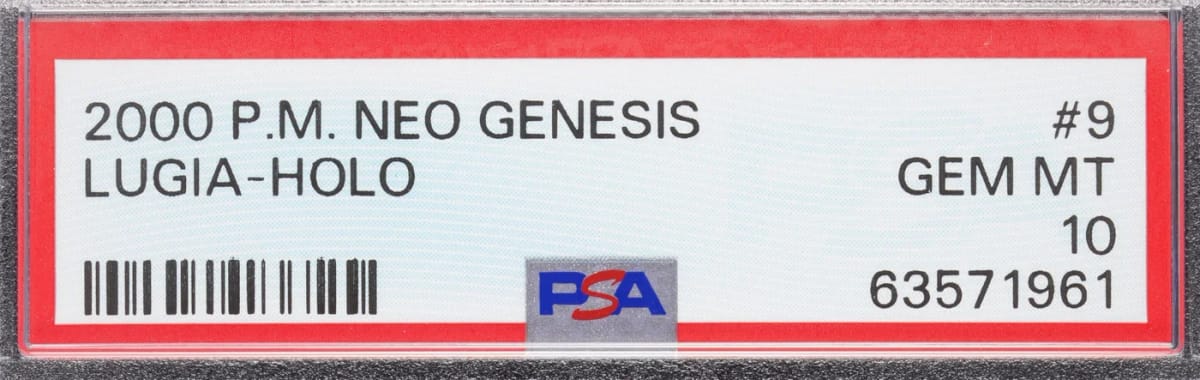
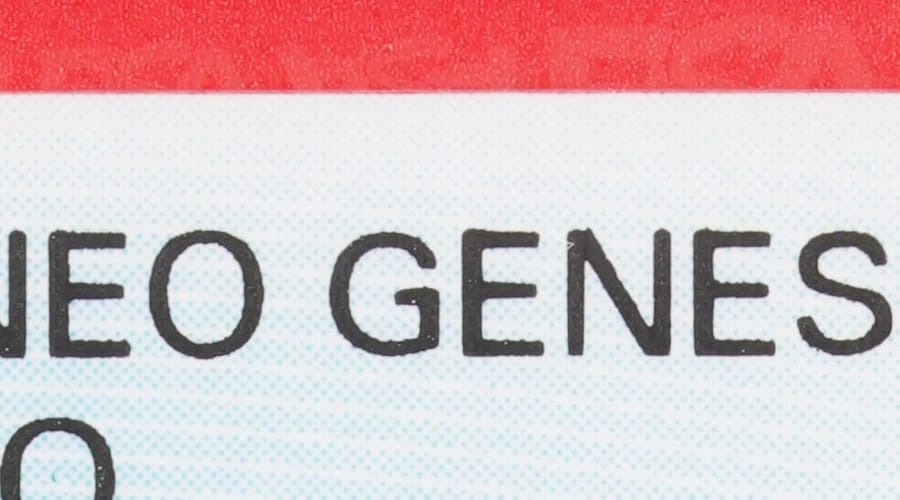
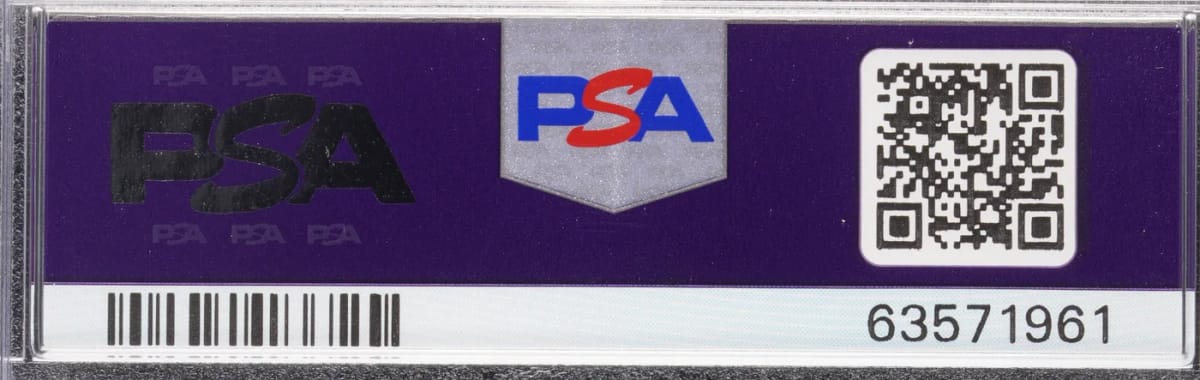
- The small PSA logos
- Around the large PSA mark. PSA says this logo shows further smaller logos under UV light.
- The LightHouse logo
- The foil PSA badge. PSA says its LightHouse logo turns on and off as the slab is tilted.
- The QR code
- This one decodes to https://www.psacard.com/cert/63571961/: PSA’s own domain, the same number as the label, and no /psa ending.
Collector-reported The same October 2026 investigations found suspect labels whose background lacked the fine dots, consistent with the text having been chemically lifted and reprinted. Photographs can hide the pattern too, through glare, compression or distance, so a missing pattern in a listing photo is a question to ask, not proof. Compare with a genuine label of the same generation under similar light.
Do not confuse the label’s hologram with the card’s holo. The LightHouse logo is PSA’s security feature; the card’s foil is the card. Both are worth checking, for different reasons.
05
The case: seams and molding
PSA documented PSA describes its holder as tamper-evident, not tamper-proof: the two halves are sonically welded, and breaking the weld leaves chips, scratches or frosting, a cloudy band along the seam. Look along every edge and corner in good light. Never try to flex or open a slab to test it.
Collector-reported Collectors have also compared holder generations with cert numbers. One widely shared summary on X flagged an older cert number (beginning 2 to 7) in a newer holder with the large molded “21” at the bottom, together with the /psa QR ending, as the combination to investigate. Keep the caveat: PSA reholders slabs legitimately, so an old number in a new case is common and fine on its own. Ask for the reholder history when the combination appears with other doubts.
06
Check the slab’s history
Photo check Expensive slabs sell more than once, and each sale leaves photographs. Two photographs of the same cert showing visibly different cards is a serious warning. The same slab changing hands is normal.
On Assetra, scan the slab or search the card and open its page: the sales ledger shows the slab photograph from every recorded sale, so earlier copies of the same grade are a scroll away. The Lugia above is one of them.
Collector-reported The case that started this autumn’s discussion is a 2002 Expedition Dragonite PSA 10, cert 65821932. After a slab with that number sold on Fanatics Collect for a reported $288,000, a collector posted on 28 October 2026 that they still owned a slab with the same number, and Elite Fourum members compared the two. PSA and Fanatics had not commented publicly in that discussion. It is an allegation under investigation, not a finding, and a reason the history check matters.
07
Before you pay
Work through the checks for the slab you are looking at. The summary says what is still missing; it is not an authentication, and it never will be. Only PSA can rule on its own holders.
08
If you already bought one
- Do not open it. A broken case ends any claim about the holder.
- Keep everything. The listing, messages, receipts, and photographs of both sides and of whatever worries you.
- Ask PSA. Contact PSA’s customer service with the cert number and your photographs.
- Tell the marketplace and your payment provider promptly; their dispute windows are short.
- Do not accuse a seller publicly before PSA or the marketplace has looked at the evidence.
09
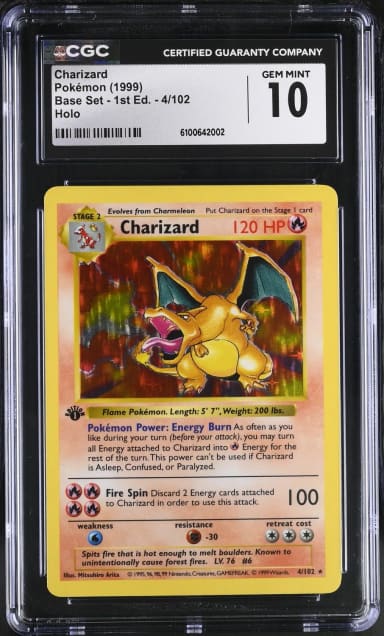
BGS and CGC slabs
The principle carries over: match the card in the case to the grader’s own record and photographs. The specific tells do not: the QR ending, the fugitive ink and the LightHouse logo are PSA’s. For Beckett and CGC, use their cert lookups and the label checks in how to verify a graded slab, which marks them on a real slab from each grader.
10
Sources
- PSA Certification Verification: the warning that genuine cert numbers are copied onto counterfeit inserts.
- PSA Security: the LightHouse logo, fugitive ink, UV logo and QR code.
- PSA Security: A Buyer’s Guide: the sonic weld and signs of tampering.
- PSA: SecureScan: cert imaging since January 2019.
- PSA cert 63571961 and the Fanatics Collect lot: the Lugia comparison. Its sale is in Assetra’s ledger.
- Elite Fourum: multiple instances of likely faked labels in PSA slabs (October 2026): the /psa QR ending and the missing fugitive-ink dots. Collector research, not a PSA finding.
- Elite Fourum: fake slab on Fanatics?: the Expedition Dragonite discussion.
- Pregrade: This week in the hobby, 7 November 2026: the reported $288,000 Dragonite sale.
- CMO333 on X: the cert prefix and holder molding summary. Collector research.
- Report on the Curcio conviction (January 2026).
About this article
Written and checked by Assetra. Prices and populations come from completed sales and the graders’ population reports as recorded in Assetra’s ledger; see how Assetra builds its figures. Spotted a mistake? Tell us.